


Enter your VAT number here and click Verify:
Your details have been verified. VAT number registered to:
,
.
Your order will now be zero rated for VAT purposes. We reserve the right to verify these details after your order request has been made and reinstate VAT if required.
Your VAT details were not recognised or were invalid. Your VAT number must be matched to your Billing Country as specified above. This is currently specified as . You do not need to enter the country code part of your VAT number as this has already been selected in your billing address details above.
The VAT number checking service is currently offline. Please supply your VAT details within the comments or special instructions field below and we will apply a VAT discount after placing your order request.

Fuel Filters


- Porsche 958 Cayenne V6 3.6L Petrol (300Hp) 2010-17
- Porsche 958 Cayenne S V6 3.0L Hybrid (380Hp) 2010-17
- Porsche 958 Cayenne S V8 4.8L Petrol (400Hp) 2010-17
- Porsche 958 Cayenne GTS V8 4.8L Petrol (400Hp) 2010-17
- Porsche 958 Cayenne Turbo V8 4.8L Petrol (500Hp) 2010-17
- Porsche 958 Cayenne Turbo S V8 4.8L Petrol (550Hp) 2010-17
Fits:
Porsche 958 Cayenne (not Diesel)
Cars with options codes:
I0K3 - Hybrid propulsion system PHEV
I2G1 - Insert for fuelling with unleaded petrol
I2G3 - Without insert for unleaded filling
I2G4 - Insert for fuelling with unleaded petrol (CARB
Diagnosis)
I2G7 - Insert for unleaded fuelling in bad fuel region
I2G8 - Insert for unleaded fuelling - MAPPS
Related reference numbers
Related, superseded, cross reference or alternative numbers for comparison.
95862013200
The product you are viewing cross references to these numbers


- Porsche 958 Cayenne V6 3.6L Petrol (300Hp) 2010-17
- Porsche 958 Cayenne S V6 3.0L Hybrid (380Hp) 2010-17
- Porsche 958 Cayenne S V8 4.8L Petrol (400Hp) 2010-17
- Porsche 958 Cayenne GTS V8 4.8L Petrol (400Hp) 2010-17
- Porsche 958 Cayenne Turbo V8 4.8L Petrol (500Hp) 2010-17
- Porsche 958 Cayenne Turbo S V8 4.8L Petrol (550Hp) 2010-17
OE Match in-tank fuel pump for the right-hand position on selected Porsche 958 Cayenne petrol and hybrid models. This replacement is intended for the applications and option codes detailed below; diesel models are excluded.
Fits
- Porsche 958 Cayenne (not Diesel)
Applicable vehicle option codes:
- I0K3 - Hybrid propulsion system PHEV
- I2G1 - Insert for fuelling with unleaded petrol
- I2G3 - Without insert for unleaded filling
- I2G4 - Insert for fuelling with unleaded petrol (CARBDiagnosis)
- I2G7 - Insert for unleaded fuelling in bad fuel region
- I2G8 - Insert for unleaded fuelling - MAPPS
Check fitment for your specific vehicle (model, year, engine) before ordering.
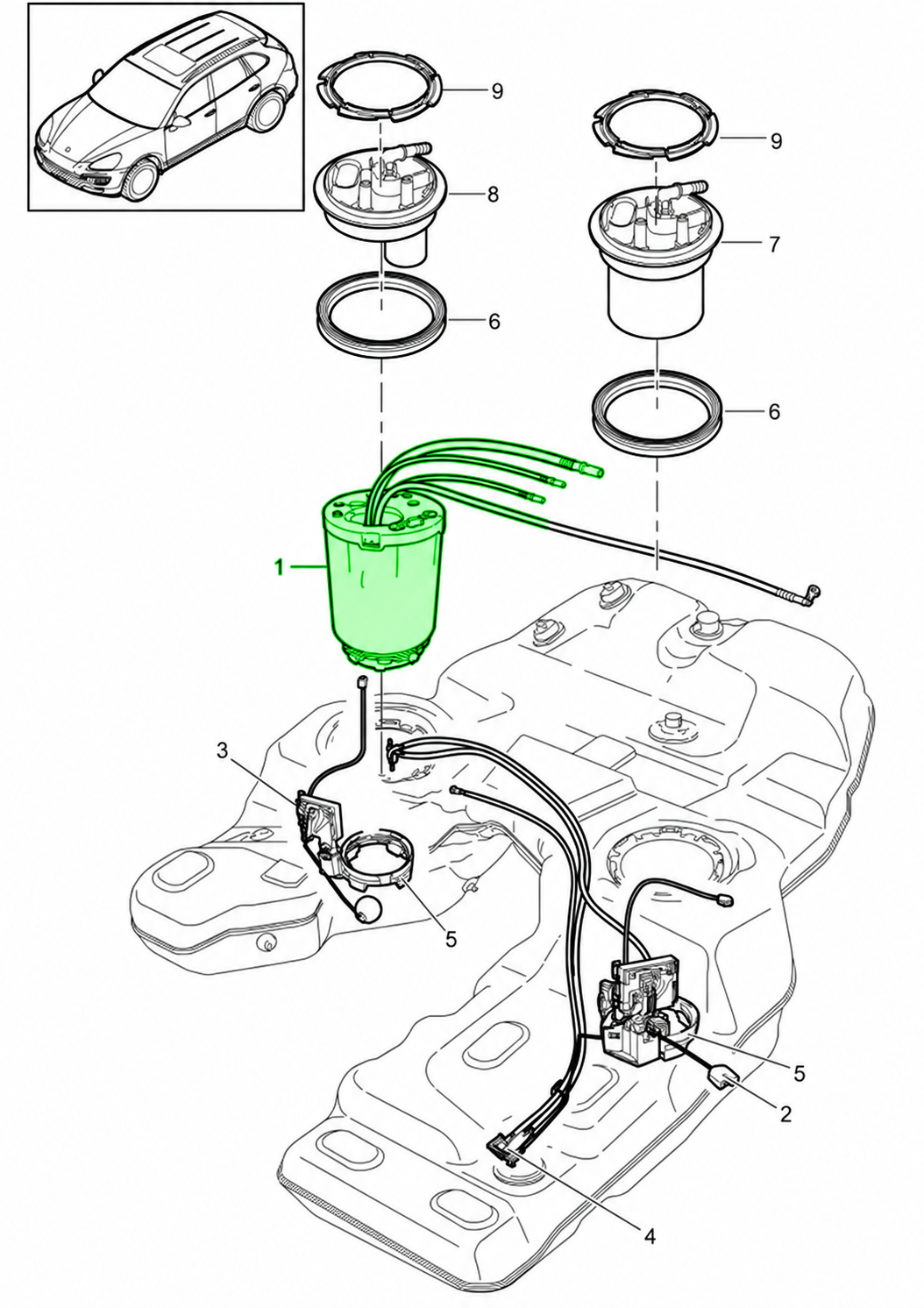
Diagram reference no 1
What This Product Does
The pump draws fuel from inside the tank and moves it into the engine's supply system. Its operation contributes to the fuel flow needed during starting and running. This is the right-hand fuel pump, rather than the separate suction jet pump or fuel-gauge sender shown in the assembly.
Functions
- Transfers fuel from the tank into the supply circuit.
- Provides fuel delivery during engine starting and operation.
Technical Details
- Part reference: 95862013200.
- Installation: inside the fuel tank, right-hand side.
- Brand: OE Match.
Symptoms of Fault
- Extended cranking or difficulty starting.
- Occasional failure to start.
- Increasing whining or humming near the tank.
- Hesitation or surging during acceleration.
- Reduced power as fuel demand rises.
- Stalling or cutting out while running.
- Low fuel pressure identified during testing.
Why Replacement Matters
A worn or faulty pump may deliver insufficient fuel or operate intermittently. Replacement is appropriate when testing confirms a pump fault. Check the electrical supply, connections, relay and filter condition first, since faults elsewhere can produce similar symptoms. Inspect associated seals and the tank for contamination when planning the repair.
FAQs
- Does pump noise confirm failure?
No. A change in noise warrants investigation, but fuel supply restrictions and electrical faults should also be considered. - What checks help confirm a faulty pump?
Fuel-pressure testing under demand, together with checks of the pump's voltage supply and electrical connections, helps distinguish pump wear from other faults. - Are the filter and sender the same component?
No. The assembly diagram identifies the filter flange, pressure-regulator flange, suction jet pump and fuel-gauge senders separately.
Related reference numbers
Related, superseded, cross reference or alternative numbers for comparison.
95862013200
The product you are viewing cross references to these numbers

Fuel Filters – Essential Protection for Your Engine and Fuel System
Fuel filters are critical service components designed to remove dirt, rust, debris and contaminants from fuel before it reaches the engine. By ensuring only clean fuel passes through the fuel system, fuel filters protect injectors, fuel pumps and internal engine components from premature wear and damage.
At Design911, we supply high-quality fuel filters from trusted original equipment and OE-approved manufacturers, engineered to meet exact flow rates and filtration standards. Whether for routine servicing, preventative maintenance or performance reliability, replacing your fuel filter at the correct interval helps maintain smooth engine operation, fuel efficiency and long-term durability.
What Do Fuel Filters Do?
Fuel filters are installed within the fuel delivery system
to trap harmful particles and impurities that can enter through fuel tanks,
lines or during refuelling. Their key functions include:
- Preventing dirt and debris from reaching fuel injectors
- Protecting fuel pumps from internal wear
- Maintaining correct fuel pressure and flow
- Supporting clean combustion and smooth engine running
Modern fuel systems rely on precise tolerances, making effective filtration essential for performance and reliability.
Why Choose Quality Fuel Filters?
High-quality fuel filters are essential because they offer:
- Correct filtration levels without restricting fuel flow
- OE-spec construction and fitment accuracy
- Durable housings and filter media for long service life
- Reliable protection for injectors and fuel pumps
Using inferior or incorrect filters can lead to reduced performance, injector failure or fuel system damage. Choosing OE-quality fuel filters helps ensure consistent engine operation and long-term reliability.
When Should You Replace a Fuel Filter?
Fuel filters should be replaced when:
- Following manufacturer-recommended service intervals
- Experiencing rough running, hesitation or reduced performance
- Replacing fuel pumps or injectors
- Carrying out major or preventative servicing
Regular fuel filter replacement helps avoid costly fuel system repairs and ensures optimal engine efficiency.
At Design911, our fuel filters meet strict quality standards to support dependable servicing and professional workshop results.
-
 Oil Filters
-
Air Filters
-
Pollen/Particle Filters
-
Belts All Types
-
Spark Plugs
-
Ignition Coils
-
Front Wiper Arms & Blades
-
Rear Wiper Arms & Blades
-
Gearbox Service Parts
-
Engine Oil & Lubricants - Mobil
-
Engine Oil & Lubricants - Total
-
Engine Oil & Lubricants - Castrol
-
Engine Oil & Lubricants - Motul
-
Engine Oil & Lubricants - Millers Oils NanoDrive
-
Engine Oil & Lubricants - Millers Oils
-
Engine Oil & Lubricants - LIQUI MOLY
-
Fuel Additives
-
Coolant / Antifreeze
-
Power Steering Oil
-
Garage PPE