


Enter your VAT number here and click Verify:
Your details have been verified. VAT number registered to:
,
.
Your order will now be zero rated for VAT purposes. We reserve the right to verify these details after your order request has been made and reinstate VAT if required.
Your VAT details were not recognised or were invalid. Your VAT number must be matched to your Billing Country as specified above. This is currently specified as . You do not need to enter the country code part of your VAT number as this has already been selected in your billing address details above.
The VAT number checking service is currently offline. Please supply your VAT details within the comments or special instructions field below and we will apply a VAT discount after placing your order request.

Fuel Pump


- Porsche 958 Cayenne V6 3.6L Petrol (300Hp) 2010-17
- Porsche 958 Cayenne S V6 3.0L Hybrid (380Hp) 2010-17
- Porsche 958 Cayenne S V8 4.8L Petrol (400Hp) 2010-17
- Porsche 958 Cayenne GTS V8 4.8L Petrol (400Hp) 2010-17
- Porsche 958 Cayenne Turbo V8 4.8L Petrol (500Hp) 2010-17
- Porsche 958 Cayenne Turbo S V8 4.8L Petrol (550Hp) 2010-17
Fits:
Porsche 958 Cayenne (not Diesel)
Cars with options codes:
I0K3 - Hybrid propulsion system PHEV
I2G1 - Insert for fuelling with unleaded petrol
I2G3 - Without insert for unleaded filling
I2G4 - Insert for fuelling with unleaded petrol (CARB
Diagnosis)
I2G7 - Insert for unleaded fuelling in bad fuel region
I2G8 - Insert for unleaded fuelling - MAPPS
Related reference numbers
Related, superseded, cross reference or alternative numbers for comparison.
95862013200
The product you are viewing cross references to these numbers


- Porsche 958 Cayenne V6 3.6L Petrol (300Hp) 2010-17
- Porsche 958 Cayenne S V6 3.0L Hybrid (380Hp) 2010-17
- Porsche 958 Cayenne S V8 4.8L Petrol (400Hp) 2010-17
- Porsche 958 Cayenne GTS V8 4.8L Petrol (400Hp) 2010-17
- Porsche 958 Cayenne Turbo V8 4.8L Petrol (500Hp) 2010-17
- Porsche 958 Cayenne Turbo S V8 4.8L Petrol (550Hp) 2010-17
OE Match in-tank fuel pump for the right-hand position on selected Porsche 958 Cayenne petrol and hybrid models. This replacement is intended for the applications and option codes detailed below; diesel models are excluded.
Fits
- Porsche 958 Cayenne (not Diesel)
Applicable vehicle option codes:
- I0K3 - Hybrid propulsion system PHEV
- I2G1 - Insert for fuelling with unleaded petrol
- I2G3 - Without insert for unleaded filling
- I2G4 - Insert for fuelling with unleaded petrol (CARBDiagnosis)
- I2G7 - Insert for unleaded fuelling in bad fuel region
- I2G8 - Insert for unleaded fuelling - MAPPS
Check fitment for your specific vehicle (model, year, engine) before ordering.
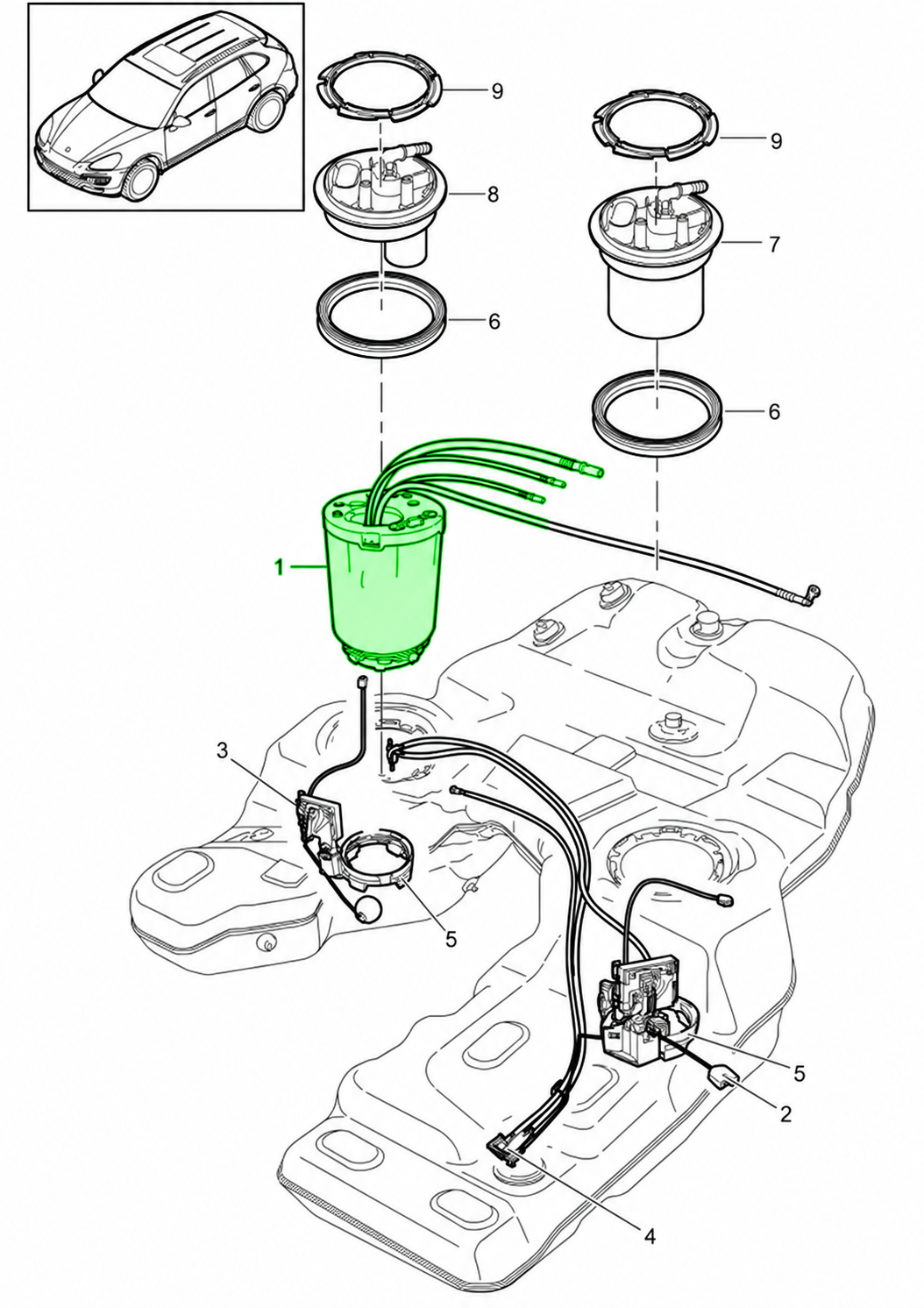
Diagram reference no 1
What This Product Does
The pump draws fuel from inside the tank and moves it into the engine's supply system. Its operation contributes to the fuel flow needed during starting and running. This is the right-hand fuel pump, rather than the separate suction jet pump or fuel-gauge sender shown in the assembly.
Functions
- Transfers fuel from the tank into the supply circuit.
- Provides fuel delivery during engine starting and operation.
Technical Details
- Part reference: 95862013200.
- Installation: inside the fuel tank, right-hand side.
- Brand: OE Match.
Symptoms of Fault
- Extended cranking or difficulty starting.
- Occasional failure to start.
- Increasing whining or humming near the tank.
- Hesitation or surging during acceleration.
- Reduced power as fuel demand rises.
- Stalling or cutting out while running.
- Low fuel pressure identified during testing.
Why Replacement Matters
A worn or faulty pump may deliver insufficient fuel or operate intermittently. Replacement is appropriate when testing confirms a pump fault. Check the electrical supply, connections, relay and filter condition first, since faults elsewhere can produce similar symptoms. Inspect associated seals and the tank for contamination when planning the repair.
FAQs
- Does pump noise confirm failure?
No. A change in noise warrants investigation, but fuel supply restrictions and electrical faults should also be considered. - What checks help confirm a faulty pump?
Fuel-pressure testing under demand, together with checks of the pump's voltage supply and electrical connections, helps distinguish pump wear from other faults. - Are the filter and sender the same component?
No. The assembly diagram identifies the filter flange, pressure-regulator flange, suction jet pump and fuel-gauge senders separately.
Related reference numbers
Related, superseded, cross reference or alternative numbers for comparison.
95862013200
The product you are viewing cross references to these numbers

Fuel Pumps – Reliable Fuel Delivery for High-Performance Porsche Engines
Fuel pumps are the heart of your Porsche’s fuel system, delivering the precise amount of fuel from the tank to the engine for smooth performance and optimal combustion. A properly functioning pump ensures your engine receives the right fuel pressure at all times, supporting acceleration, responsiveness, and efficiency.
At Design911, we stock a comprehensive range of genuine and high-quality fuel pumps for the transaxle models, 911, Boxster, Cayman, Cayenne, Macan, and Panamera models. Each pump is precision-engineered for consistent flow, durability, and reliability — ensuring dependable fuel delivery for both road and track conditions.
What Do Fuel Pumps Do?
The fuel pump’s primary role is to move fuel from the tank
to the engine’s fuel rail or injectors under controlled pressure. It:
- Maintains
consistent fuel pressure for smooth performance.
- Delivers
precise fuel volume to match engine demand.
- Supports
efficient combustion and emissions control.
- Ensures strong acceleration and throttle response.
Whether mechanical or electric, the fuel pump is essential to maintaining performance and reliability in your Porsche’s advanced fuel system.
Why Do Fuel Pumps Fail?
Fuel pumps are exposed to constant mechanical motion, heat,
and pressure, which can lead to wear over time. Common causes of failure
include:
- Contaminated
fuel causing clogging or abrasion.
- Electrical
issues such as relay or wiring faults.
- Low
fuel levels reducing cooling and lubrication.
- Corrosion
or debris buildup from aged fuel tanks.
- Internal wear from high mileage or ethanol-blended fuels.
Signs of a failing pump include engine hesitation, loss of power, difficulty starting, stalling under load, or whining noises from the fuel tank.
Why Replace a Faulty Fuel Pump?
A failing fuel pump can lead to inconsistent performance, fuel starvation, or complete engine shutdown. Replacing it restores smooth operation and ensures reliable power delivery.
Benefits of replacement include:
- Improved engine performance and responsiveness.
- Consistent fuel pressure and flow.
- Prevention of stalling or power loss.
- Long-lasting, manufacturer-quality reliability.
All fuel pumps in our range are designed for precision fitment, high efficiency, and low-noise operation, providing dependable performance for both everyday driving and high-speed conditions.
1. What does a fuel pump do in a Porsche?
The fuel pump delivers fuel from the tank to the engine at
precise pressure levels. It ensures smooth combustion, reliable power delivery,
and consistent performance under all driving conditions — essential for
maintaining Porsche’s engineering excellence.
2. What are the symptoms of a failing fuel pump?
Typical signs include difficulty starting, loss of
power, hesitation during acceleration, whining noises from the
fuel tank, or engine stalling. A weak or failing pump may struggle
to maintain consistent fuel pressure.
3. Can I drive my Porsche with a bad fuel pump?
Driving with a failing pump is not recommended. A
weak pump can cause intermittent stalling, reduced performance, or total
engine failure. Replacing it promptly prevents damage to the injectors or
fuel system.
4. How long does a fuel pump last in a Porsche?
Fuel pumps typically last 100,000–150,000 miles,
depending on fuel quality and driving habits. Regular maintenance, using
premium fuel, and avoiding running on low fuel levels can help extend lifespan.