




Enter your VAT number here and click Verify:
Your details have been verified. VAT number registered to:
,
.
Your order will now be zero rated for VAT purposes. We reserve the right to verify these details after your order request has been made and reinstate VAT if required.
Your VAT details were not recognised or were invalid. Your VAT number must be matched to your Billing Country as specified above. This is currently specified as . You do not need to enter the country code part of your VAT number as this has already been selected in your billing address details above.
The VAT number checking service is currently offline. Please supply your VAT details within the comments or special instructions field below and we will apply a VAT discount after placing your order request.


.jpg)
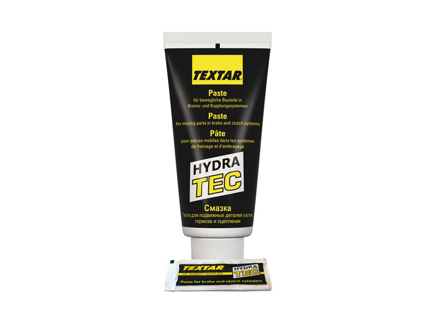
Hydra tec lubricant for maintenance work and protection Textar
Available in 75ml Tube or 5ml Sachet
The Advantages of Hydra Tec:
- Facilitates the installation of hydraulic brake components
- Tested compatibility with commercially available braking fluids (DOT3, DOT4, DOT4LV, DOT5.1)
- Free of mineral oils and compatible with EPDM rubber
- In addition, running surfaces are protected against corrosion
Hydra Tec is suitable for lubricating:
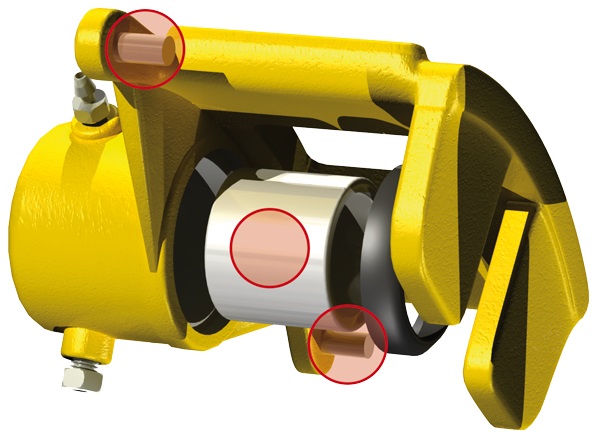
- Cylinder running surfaces
- Pistons
- Sealing elements
Application:
Apply a thin layer of Hydra Tec on the marked sections.
Note:
Hydra Tec should be applied thinly and evenly.
Never use mineral oils or greases as substitutes.
Do not apply the product on friction surfaces of brake pads or brake discs.
Find out about Textar product verification here


Brake fluid is one of the most important fluids in a car as without it, stopping the vehicle safely would be impossible. The Brake fluid transmits the force exerted by the driver on the brake pedal onto the wheel brake.
To ensure perfect operation of the brakes, the brake fluid must be changed regularly during inspection or maintenance and tested with the correct brake fluid tester.
Brake fluid should be changed every two years.
The higher the DOT class, the higher the boiling temperature and wet boiling point. Higher DOT classes tend to allow longer maintenance intervals. The DOT standards are based on the American FMVSS-116 standard of the Department of Transportation (DOT).
Boiling Point and Viscosity
Dry Boiling Point - describes the property of the sealed new brake fluid. In this state, the brake fluid is almost anhydrous (substance containing no water). The dry boiling point is usually between 240 and 280°C.
Wet Boiling Point - determines the property of the brake fluid at the end of its life cycle, at a water content of 3.5% the fluid should be replaced. This defined wet boiling point must not be undercut.
Viscosity - describes the flow rate of the brake fluid. The lower the viscosity, the faster the brake fluid flows through the brake system, and the faster the brake signals are transmitted.
Important Notes
• Brake fluid is poisonous and a hazardous waste.
• Be careful when changing. The fluid weakens paints and plastics.
• It must not come into contact with eyes or skin. Always rinse spilled liquid with water.
• Do not pour the liquid into drinking water or mix with used oil.
• The colour of the brake fluid reveals nothing about its quality.
• Brake fluid should be stored in its original packaging and in a dry, cool and well-ventilated place.
Find out about Textar product verification here
Related reference numbers
Related, superseded, cross reference or alternative numbers for comparison.
95002
The product you are viewing cross references to these numbers

.jpg)
.jpg)
.jpg)
Brake fluid DOT 4 LV (Low Viscosity) Textar.
Textar DOT 4 LV (Low Viscosity) is especially recommended for use in hydraulic brake and clutch systems of vehicles fitted with ESP, ABS and ASR with a high boiling point and outstanding performance at very low temperatures.
DOT 4 LV (Low Viscosity)
Dry Boiling Point ≥ 260° C
Wet Boiling Point ≥ 165° C
Viscosity at -40C < 750 mm2 /s
Brake fluid is one of the most important fluids in a car as without it, stopping the vehicle safely would be impossible. The Brake fluid transmits the force exerted by the driver on the brake pedal onto the wheel brake.
To ensure perfect operation of the brakes, the brake fluid must be changed regularly during inspection or maintenance and tested with the correct brake fluid tester.
Brake fluid should be changed every two years.
The higher the DOT class, the higher the boiling temperature and wet boiling point. Higher DOT classes tend to allow longer maintenance intervals. The DOT standards are based on the American FMVSS-116 standard of the Department of Transportation (DOT).
Boiling Point and Viscosity
Dry Boiling Point - describes the property of the sealed new brake fluid. In this state, the brake fluid is almost anhydrous (substance containing no water). The dry boiling point is usually between 240 and 280°C.
Wet Boiling Point - determines the property of the brake fluid at the end of its life cycle, at a water content of 3.5% the fluid should be replaced. This defined wet boiling point must not be undercut. <
Viscosity - describes the flow rate of the brake fluid. The lower the viscosity, the faster the brake fluid flows through the brake system, and the faster the brake signals are transmitted.
Important Notes
• Brake fluid is poisonous and a hazardous waste.
• Be careful when changing. The fluid weakens paints and plastics.
• It must not come into contact with eyes or skin. Always rinse spilled liquid with water.
• Do not pour the liquid into drinking water or mix with used oil.
• The colour of the brake fluid reveals nothing about its quality.
• Brake fluid should be stored in its original packaging and in a dry, cool and well-ventilated place.
Find out about Textar product verification here
Related reference numbers
Related, superseded, cross reference or alternative numbers for comparison.
95006
The product you are viewing cross references to these numbers

Brake fluid is one of the most important fluids in a car as without it, stopping the vehicle safely would be impossible. The Brake fluid transmits the force exerted by the driver on the brake pedal onto the wheel brake.
To ensure perfect operation of the brakes, the brake fluid must be changed regularly during inspection or maintenance and tested with the correct brake fluid tester.
Brake fluid should be changed every two years.
The higher the DOT class, the higher the boiling temperature and wet boiling point. Higher DOT classes tend to allow longer maintenance intervals. The DOT standards are based on the American FMVSS-116 standard of the Department of Transportation (DOT).
Boiling Point and Viscosity
Dry Boiling Point - describes the property of the sealed new brake fluid. In this state, the brake fluid is almost anhydrous (substance containing no water). The dry boiling point is usually between 240 and 280°C.
Wet Boiling Point - determines the property of the brake fluid at the end of its life cycle, at a water content of 3.5% the fluid should be replaced. This defined wet boiling point must not be undercut.
Viscosity - describes the flow rate of the brake fluid. The lower the viscosity, the faster the brake fluid flows through the brake system, and the faster the brake signals are transmitted.
Important Notes
• Brake fluid is poisonous and a hazardous waste.
• Be careful when changing. The fluid weakens paints and plastics.
• It must not come into contact with eyes or skin. Always rinse spilled liquid with water.
• Do not pour the liquid into drinking water or mix with used oil.
• The colour of the brake fluid reveals nothing about its quality.
• Brake fluid should be stored in its original packaging and in a dry, cool and well-ventilated place.
Find out about Textar product verification here